by SearchKings | Nov 20, 2026 | Blog
Most exhibitors put their budget and attention into the stand itself, then scramble for the smaller items in the final week: the roll-up banner for the entrance, a brochure stand for the literature and a few framed posters for the walls. These items are more affordable compared with the stand, but they are the ones visitors touch, read and interact with.This guide covers what drives the pull-up banner price, how Scan Display’s four roll-up models differ, which brochure stand suits which space, and the print file specifications and deadlines that keep everything arriving on time. It ends with a short checklist you can work through before any show.
Key takeaways
- Model drives price. A pull-up banner price depends mostly on the base you choose (Wing, Wing Lite, Just Lite or Econo), whether the graphic is single or double-sided, and whether you are buying a full unit or only a reprint.
- Reloadable bases cut repeat costs. The Wing and Wing Lite carry a lifetime guarantee and take reprinted graphics, so a campaign change only needs a new print, not a new stand.
- Artwork errors cost more than banners. Supply files at actual size, at 250dpi or higher, with fonts converted to curves and logos in vector format to avoid reprints.
What affects the price of a pull-up banner?
A pull up banner (also called a roll-up banner) is a printed graphic that rolls into a spring-loaded base and pulls up onto a pole. Two banners that look identical \ can differ a lot in price, and the difference usually comes down to five things.
- The base mechanism. A heavier, double-sided base costs more than a single-sided foot or a lightweight economy base, but it is more stable and lasts longer.
- Single or double-sided graphics. A double-sided banner needs two prints and a base built to hold both, which means paying slightly more for the additional graphic. Print size. The taller 2200mm prints on the Wing and Wing Lite use more material than the 2010mm prints on the Just Lite and Econo.
- New unit or reprint. If you already own a reloadable base, a new campaign only needs a new print, which is the cheapest way to refresh your branding.
- Quantity, VAT and delivery. Quoted prices are usually exclusive of VAT and delivery, so check both when comparing suppliers, and ask about rates for multiple units if you are kitting out several branches or a national roadshow.
The lowest pull-up banner price is not always the cheapest choice. A budget base used once for a directional sign is good value. The same base used at ten shows a year will likely need replacing, while a reloadable base with a lifetime guarantee only ever needs new graphics.
Comparing Scan Display’s roll-up banner models
Scan Display offers four roll-up banners, each built for a different level of use. The table below sets out the differences that matter most when you are choosing one.
| Model |
Print size |
Sides |
Reloadable |
Best for |
Price (excl. VAT) |
| Wing |
845mm x 2200mm |
Single or double |
Yes, lifetime guarantee |
Frequent exhibitors and high-traffic positions |
[Client to confirm] |
| Wing Lite |
845mm x 2200mm |
Single |
Yes, lifetime guarantee |
Regular use where a compact foot suits the space |
[Client to confirm] |
| Just Lite |
845mm x 2010mm |
Single |
Possible, but repeated reloading is not recommended |
Short-term use on flat surfaces |
[Client to confirm] |
| Econo |
800mm x 2010mm |
Single |
Not intended for reloading |
Indoor, temporary graphics such as event directional signage |
[Client to confirm] |
Wing and Wing Lite: for repeat use
The Wing is Scan Display’s most durable roll-up. Its double-sided base makes it more stable than the other options, and it can carry a graphic on one or both sides, which is useful for a banner standing in an open walkway. The Wing Lite takes the same 845mm x 2200mm print on a more compact, one-sided base. Both carry a lifetime guarantee and accept reprinted graphics, so they suit companies that exhibit several times a year or change their messaging between campaigns.
Just Lite and Econo: for short-term jobs
The Just Lite is a simple, stable option for flat surfaces and short-term use. It can be reloaded, but the mechanism is not built for regular graphic changes. The Econo is designed for indoor, temporary graphics such as directional signage at a conference or a one-off product launch. If the banner is likely to be thrown away after the event, there is little reason to pay for a lifetime-guaranteed base.
Reloadable roll-up banner graphics: when a reprint makes sense
Reloading means removing the old graphic from the base and fitting a newly printed one. On the Wing and Wing Lite, the bases are designed for this, which changes how you should budget. Instead of buying new banners for every campaign, you buy the bases once and then pay only for prints as your products, dates or offers change.
This works best when your banners share a standard size. Keeping all your roll-ups on the same model means any graphic fits any base, so one branch can lend a base to another and a damaged print can be swapped without waiting for a whole new unit.
Choosing brochure stands for exhibitions and reception areas
A loose pile of brochures on a counter looks untidy and gets knocked over. A brochure stand keeps literature upright, visible and easy to take, and it frees counter space for conversations and product demos.
Scan Display’s brochure stands include the Zed Up Clear, which comes with a carry case, and the Stacker Straight. Both are collapsible and portable, and both are available to hire or buy. When choosing a brochure stand, consider:
- Where it will stand. A freestanding unit works at a stand entrance or in a reception area, while a desktop unit suits a counter or registration desk.
- How often you will move it. If it travels between shows or branches, a collapsible stand with a case protects it in transit.
- Hire or buy. Hiring makes sense for a once-off event. Buying makes sense if you exhibit regularly or need permanent literature display in a showroom.
- What you are displaying. Check the brochure sizes you print before you choose, so the pockets fit your literature.
For posters, price lists and floor plans, aluminium clip frames are a practical companion. They come in A0 to A5 as standard, with custom sizes available, and can be wall-mounted, hung or used freestanding on a stand.
Print logistics: file specs that prevent costly reprints
Most last-minute problems with banners and display graphics are not caused by the hardware. They come from artwork that is the wrong size, too low in resolution or built in software that print production cannot use. Scan Display’s graphic help sheet sets out the requirements. The main points are:
- File format. Save artwork as a JPG or PDF at actual size.
- Resolution. Artwork should not be lower than 250dpi.
- Logos and fonts. Supply logos as vector files (Illustrator, PDF or EPS) and supply fonts or convert them to curves.
- Colour. Give Pantone references for brand colours. Printing uses CMYK ink, so an exact match is not guaranteed and a proof is worth checking.
- Bleed. Allow 10mm bleed on all sides for vinyl prints and 50mm for fabric prints, with no crop marks.
- Software. Files made in Word, PowerPoint or CorelDRAW cannot be accepted as final artwork.
- Proof. Supply a PDF or hard copy proof of the full layout with your files.
Roll-up banner artwork: mind the top and bottom
Roll-up graphics need extra space at the top and bottom, because part of the print is clamped into the header rail and part stays hidden inside the base. Scan Display’s roll-up artwork guide shows these areas for each model, and nothing important (logos, contact details or calls to action) should sit inside them. Keep your key message in the top two-thirds of the banner, where it is visible above the heads of visitors and tables.
Build in time before the show
Artwork approval almost always takes longer than planned, because marketing, sales and sometimes a partner brand all need to sign off. Brief your supplier early, confirm the production lead time for each item, and set your internal artwork deadline well before it. [Client to confirm standard production lead times for roll-ups, brochure stands and clip frames.]
Trade show checklist for exhibitors
Work through this list in the weeks before any exhibition, alongside your stand and event infrastructure bookings:
- Confirm your stand size and layout, and decide where each banner, brochure stand and frame will go.
- Choose roll-up models based on how often you exhibit, not only on the lowest price.
- Check whether existing reloadable bases only need new graphics.
- Decide whether to hire or buy brochure stands.
- Brief your designer with the correct print sizes and bleed for each item.
- Get internal sign-off on artwork and send print-ready files with a PDF proof.
- Confirm production and delivery dates with your supplier.
- Pack spare brochures and check all bases and stands on arrival before the show opens.
If you exhibit often, it is also worth looking at a portable stand such as the fabric pop-up system, which pairs well with roll-ups and brochure stands for roadshows.
Frequently asked questions
How much does a pull up banner cost?
The price depends on the model, whether it is single or double-sided, and whether you need a full unit or only a reprint. Economy bases cost the least, while reloadable bases with a lifetime guarantee cost more upfront but less over time. Request a quote for current pricing.
What size is a standard pull-up banner?
Scan Display’s Wing and Wing Lite take an 845mm x 2200mm print, the Just Lite takes 845mm x 2010mm, and the Econo takes 800mm x 2010mm.
Can I reuse my roll-up banner base with a new graphic?
Yes, on the Wing and Wing Lite, which are designed to be reloaded and carry a lifetime guarantee. The Just Lite can be reloaded but is not recommended for repeated changes.
What file format should I send for banner printing?
Send a JPG or PDF at actual size and at least 250dpi, with vector logos, fonts converted to curves and the correct bleed. Word, PowerPoint and CorelDRAW files are not accepted as final artwork.
Get your trade show essentials sorted
Scan Display has supplied exhibition, event and display products since 1996, with branches in Johannesburg, Cape Town, Durban, Gqeberha and Botswana. Whether you need a single roll-up for a launch or banners, brochure stands and frames for a national roadshow, the team can advise on the right models and check your artwork before it goes to print. Request a quote with your quantities and show dates to get current pricing.
by SearchKings | Nov 3, 2026 | Mobile Exhibitions
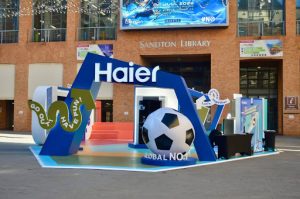
A national retailer can spend months on a product launch and still watch it disappear into the noise of a crowded shopping centre. The activations that don’t disappear share a pattern: they’re built to stop foot traffic, not just decorate it. This guide covers what a mall activation actually involves, how to plan one that performs, and how to measure whether it worked.
Key takeaways
- Definition: a mall activation is a temporary, staffed brand experience built for a specific centre and a specific window of foot traffic — different from a trade show stand or a permanent retail fixture.
- What converts: the activations that convert combine a physical build (island, pop-up counter, sampling station) with a reason to stop — sampling, a demo, an interactive element, or a launch offer.
- ROI is measurable if you decide what to track before build day: footfall past the site, dwell time, leads or sign-ups captured, and sales lift in-centre or nearby.
What is a mall activation, exactly?
A mall activation is a temporary, built brand presence inside a shopping centre — an island, kiosk, or pop-up structure staffed for a set period, designed to intercept shoppers who weren’t looking for the brand and give them a reason to stop. It sits in a different category from a trade show stand (built for a captive, self-selected audience at an industry event) and from permanent retail shopfitting (a fixed store or counter that doesn’t move).
The distinction matters for planning: a mall activation has to work in a space it wasn’t purpose-built for, compete with the mall’s own visual noise, and earn attention from people mid-errand. That’s a design brief, not just a print job — which is why the build typically involves interior designers and graphic designers working together on the space, not just a branded gazebo dropped into a walkway.
Why marketing managers are turning to activations over pure media spend
Foot traffic in a well-trafficked centre is attention that’s already there and already engaged in physical retail behaviour — a different mindset from someone scrolling past a digital ad. A mall activation converts a share of that passing traffic into direct product contact: a sample in hand, a demo tried, a question answered by a real person. For a launch, that direct contact is often worth more per interaction than a broader but shallower media buy, particularly when the goal is trial, not just awareness.
The trade-off is that activations are labour and logistics-heavy compared to digital media: they require a physical build, mall approval, on-site staffing, and breakdown. That’s the case for using a specialist rather than running it in-house — the physical and logistical load is exactly what a dedicated events team is built to absorb.
What goes into a high-impact activation
The structures that work in mall environments tend to draw on a small set of proven formats rather than one-off custom builds every time, which keeps both cost and risk down:
- Islands and pop-up counters built for high-traffic thoroughfares and centre courts, sized to the mall’s own space restrictions.
- Modular, reusable systems such as a fabric pop-up system or Modulbox, which let the same hardware be reconfigured and reused across multiple centres or campaign phases rather than rebuilt from scratch each time.
- Sampling and demo stations, staffed and stocked, which are what actually convert foot traffic into product trial.
- Furniture, counters and AV to round out the space — registration or promo counters, seating, and screens for product video or interactive content.
- A reason to stop: a competition entry, a sample, a live demo, or a launch-day offer. The build gets attention; this is what holds it.
Scan Display has run mall and brand activations for clients including Dove and Elizabeth Arden, and the in-house team spans interior designers, graphic designers, carpenters and printers — which means the same team that designs the space also builds and prints it, rather than the brief passing between three separate suppliers.
Planning and logistics: what happens before build day
Mall activations run on the centre’s terms, not the brand’s. Before anything is built, an account executive will typically be managing:
- Mall approval and site booking: most centres run a formal process for activation space, often booked months ahead for prime spots like a centre court or main entrance during peak trading periods.
- Timing against the retail calendar: activations tied to school holidays, month-end pay cycles, or seasonal peaks capture materially more footfall than the same build on a quiet trading week.
- Compliance and safety sign-off fire: egress, electrical certification, and structural approval for anything built rather than simply placed.
- Delivery and breakdown windows: most centres restrict build and strike to specific overnight or early-morning hours, which has to be factored into the production schedule from day one.
This is the part of the brief that’s easy to underestimate from the marketing side and is usually where an experienced activation partner earns its fee — not just in the build, but in not getting the booking wrong.
Measuring ROI: what to track before, not after
The most common reason a marketing manager can’t prove an activation worked is that nobody decided what “worked” meant before build day. Set the metrics up front:
- Footfall past the site: most malls can supply centre-wide footfall data, and a people counter at the activation itself gives you a conversion rate from passers-by to engaged visitors.
- Dwell time: how long people spend at the activation, a strong proxy for how compelling the experience actually was.
- Leads or sign-ups captured: competition entries, database sign-ups, or app downloads, if the activation includes a data-capture element.
- Sales lift in-centre or at nearby stores during and immediately after the activation window, compared against a baseline period.
- Social and earned reach: user-generated content and shares, if the activation is visually distinctive enough to be photographed unprompted.
None of these requires guesswork if they’re built into the brief from the start — the harder mistake is trying to reconstruct them after the fact.
What to look for in a mall activation specialist
A few things worth checking before you brief an agency or supplier:
- In-house design and production, so the same team that concepts the space also builds and prints it, rather than managing multiple subcontractors on your behalf.
- Multi-city reach, if the campaign is running across several centres — Scan Display operates from branches in Johannesburg, Cape Town, Durban, Gqeberha and Botswana, which matters for national rollouts on a tight timeline.
- A track record with FMCG and retail brands specifically, since mall activation logistics differ meaningfully from corporate exhibition stands.
- Sustainability credentials, increasingly a procurement requirement for larger brands — Scan Display is a member of the Event Greening Forum and has been recognised at recent EXSA industry awards for sustainable stand practices.
If you’re weighing an activation against a trade show presence instead, our guide to brochure stands, pull-up banners and print logistics covers the collateral side of exhibition stands specifically.
FAQ
- How much does a mall activation cost? Cost depends on the build’s size and complexity, staffing days, the number of centres, and whether the hardware is custom or drawn from a reusable modular system. Because every brief differs, request a quote with your target centres and dates for an accurate figure.
- How far in advance should we book a mall activation? Prime mall locations, especially centre courts during peak retail periods, are typically booked months ahead by the centre itself — start the booking conversation as early as possible even if the creative brief is still being finalised.
- How is a mall activation different from a trade show stand? A trade show stand is built for a self-selected, industry-specific audience at a bounded event; a mall activation is built to intercept general foot traffic that wasn’t necessarily looking for the brand, inside a working retail environment with its own rules on build, safety and teardown.
Ready to plan yours
A mall activation that performs is designed backwards from the metric you actually care about — footfall converted, leads captured, or product trialled — not just from the visual. Scan Display has been building exhibition, event and retail activations across Southern Africa since 1996; get a quote for your next campaign.
by SearchKings | Oct 28, 2026 | Trade Shows
Most trade show collateral gets ordered in the last fortnight before a show, which is exactly when the wrong choice — a base too flimsy for a busy hall, a brochure stand too small for the print run — becomes a same-day problem instead of a planning one. This guide covers the two workhorses of any stand, brochure stands and pull-up banners, what actually separates the options, and what drives what you’ll pay.
Key takeaways
- Different jobs: brochure stands and pull-up banners solve different problems — one displays and dispenses printed material, the other carries your branding message at a distance — most stands need both.
- Price is quote-based, not fixed online, for both product lines, because size, print method, base durability and order volume all move the number; the fastest way to a real figure is a quote against your actual spec.
- A durable, reloadable base is usually the better economics if you’re exhibiting more than once a year, since only the graphic needs reprinting between shows.
Brochure stand or pull-up banner — what each is actually for
A brochure stand holds and dispenses printed material — brochures, flyers, price lists — at a stand, reception, or retail counter. It’s a functional fixture, not primarily a branding surface, though most models carry a printed header or panel.
A pull-up (roll-up) banner is a freestanding printed graphic, usually the single largest piece of branding on a stand that doesn’t require a full custom build. It carries the message someone reads from a distance — brand name, headline offer, key visual — rather than material they take away.
Most exhibitors need both: the banner to draw the eye and communicate the headline message, the brochure stand to hand off detail to anyone who stops. Treating them as a single line item on a quote is a common way to end up under-specified on one or the other.
Brochure stand options compared:
Scan Display offers three brochure stand models, each suited to a different footprint and volume of material:
- Zed Up Clear (with case): a collapsible, transparent-panel stand that packs into its own carry case, suited to exhibitors who need something light and quick to set up and break down repeatedly across a show circuit.
- Stacker Straight: a straightforward pocketed stand for a single, focused literature offering at a counter or stand entrance.
- Fanfare 24 Pocket t: the highest-capacity option of the three, built for exhibitors distributing multiple brochure titles or a full product range from one fixture.
Match the model to how much material you’re actually distributing and how often the stand travels — a 24-pocket unit is wasted capacity for a single flyer, and a single-pocket stand won’t cope with a full catalogue range.
Pull-up banner options compared
Scan Display’s roll-up banner range is built around one main trade-off: how many shows the banner needs to survive.
- Wing double-sided base, the most durable option in the range, with a lifetime guarantee on the base and single- or double-sided graphic printing (845mm × 2200mm). The right choice for a banner that will be reused across a full show calendar.
- Wing Lite: the same lifetime-guaranteed base, single-sided only (845mm × 2200mm) — durable, with a lighter footprint than the Wing.
- Just Lite: a simple, stable base for flat surfaces (845mm × 2010mm), intended for short-term use; the base can be reloaded with a new graphic but isn’t built for repeated reloading.
- Econo Banner: an indoor temporary graphic solution (800mm × 2010mm), suited to short-run or single-event use such as directional signage rather than a reusable brand asset.
The lifetime-guaranteed bases (Wing and Wing Lite) cost more upfront but only need a reprinted graphic slotted into the same base for the next show — worth weighing against a cheaper base bought fresh for every event if you’re exhibiting more than once or twice a year.
What actually drives the price
Neither brochure stands nor roll-up banners are sold at a fixed listed price on Scan Display’s site — both are quoted against your actual spec, because several variables move the number more than the base model does:
- Size and print format: larger graphics and taller banner formats use more substrate and ink.
- Base durability: a lifetime-guaranteed base (Wing, Wing Lite) costs more upfront than a short-term base (Just Lite, Econo) but reduces cost per show over a season.
- Single- vs double-sided printing: double-sided graphics roughly double the print cost on a given banner.
- Order volume: ordering banners or brochure stands for a multi-city roadshow or several sales regions at once is where per-unit pricing improves most; this is the volume order most worth quoting properly rather than ordering one unit at a time as each show comes up.
- Branding complexity: a simple logo-and-headline graphic prints faster and cheaper than a full photographic, multi-panel design.
If budget certainty matters before a show is confirmed, ask for a quote with two or three size/base combinations up front rather than settling the spec after the number comes back — it’s a faster way to land on the right trade-off.
Getting collateral ready before expo season
The run-up to major expo seasons is when print queues get tightest and lead times matter most. A few things that keep collateral on schedule:
- Brief the final artwork early; print production, not design, is usually the actual bottleneck close to a show date.
- Order banners and stands together with your main stand build where possible, rather than as a separate last-minute add-on, so they’re accounted for in the same production and delivery schedule.
- Use a supplier with production close to the venue: Scan Display operates from branches in Johannesburg, Cape Town, Durban, Gqeberha and Botswana, which shortens the logistics chain for shows at major venues like Sandton Convention Centre, the CTICC or Durban ICC compared with shipping collateral in from a single national hub.
- If the stand itself is reusable, only the graphics need reprinting between shows — worth factoring into a multi-show annual budget rather than pricing each show as a standalone spend.
For anything beyond banners and brochure stands — full shell scheme, counters, furniture or AV — see Event Infrastructure for the wider range. And if the collateral is destined for a shopping centre activation rather than an industry trade show, see our guide to high-impact mall activations — the briefing and approvals process is different from a standard trade show stand.
FAQ
- How much does a pull-up banner cost? There’s no fixed online price — cost depends on size, base durability (short-term versus lifetime-guaranteed), single- versus double-sided printing, and order quantity. Request a quote with your specs for an accurate figure, and ask for volume pricing if you’re ordering for more than one show or region.
- How long do brochure stands last? It depends on the model and how often it’s transported and rebuilt. The Zed Up Clear and Stacker Straight are built for repeated setup and breakdown across a show circuit; frequency of travel affects wear more than shelf life at a fixed venue.
- Can banner graphics be reprinted and reused in the same base? Yes, on the Wing and Wing Lite ranges, which carry a lifetime guarantee on the base specifically so the graphic can be reprinted and reloaded for each new show rather than replacing the whole unit. The Just Lite base can also be reloaded, though it isn’t built for repeated reloading in the way the Wing range is.
- How far ahead of a show should we order? As early as the artwork allows, and ideally in the same order as your main stand build — print queues tighten in the run-up to peak expo months, and ordering banners and brochure stands as a last-minute add-on is the most common cause of a rushed or compromised finish.
Ready to quote your show collateral
Whether it’s one banner or a full multi-city roadshow kit, get a quote from Scan Display with your sizes, quantities and show dates, and expect pricing that reflects the actual spec rather than a generic rate card.

by SearchKings | Aug 7, 2026 | Exhibition, Exhibition stand builders, Exhibition Stands, Exhibition Stands
In the highly competitive corporate landscape of Gauteng, making a memorable impact at shows requires more than a standard shell scheme. Partnering with an experienced exhibition stand builder ensures your brand commands attention, engages prospective clients, and maximises your return on investment.
At Scan Display, we specialise in premium exhibition stand design and turnkey manufacturing tailored to your precise marketing objectives. From initial 3D conceptualisation to final on-site handovers, our team manages the entire lifecycle of your build. This end-to-end capability guarantees that your brand identity is seamlessly translated into a physical, high-impact environment.
Expertise Across Johannesburg’s Premier Venues
Successfully navigating major exhibition spaces requires local expertise. As established exhibition stand builders in Johannesburg and around South Africa, we possess deep operational knowledge of the region’s leading venues, including:
- The Sandton Convention Centre
- Gallagher Convention Centre
Our longstanding relationships with venue organisers and thorough understanding of local logistics ensure a frictionless build process. We handle structural compliance, electrical compliance, and complex rigging requirements, leaving your team free to focus entirely on your event strategy and lead generation.
Key Takeaway: Local regulatory knowledge is non-negotiable. Partnering with an on-the-ground specialist mitigates the risk of structural sign-off delays and unexpected venue non-compliance.
The Strategic Power of Turnkey 3D Design
Modern exhibition design relies heavily on advanced spatial technology. Our in-house design studio utilises cutting-edge 3D rendering software to build digital prototypes of your stand before a single piece of wood is cut.
Strategic 3D design goes beyond aesthetics; it optimises the functionality of your commercial space. We meticulously plan customer touchpoints, incorporating:
- Dedicated presentation zones to capture broad foot traffic.
- Secure meeting rooms for private, high-value B2B negotiations.
- Interactive product demonstration areas to drive hands-on engagement.
By treating the layout as a physical marketing funnel, we ensure that your sales team can seamlessly guide visitors from casual interest to qualified lead capture.
Turnkey Manufacturing and Sustainable Solutions
Whether you require a double-decker structural build or an immersive experiential pavilion, our Johannesburg production facility utilises state-of-the-art technology to manufacture flawless exhibition stands. Furthermore, we integrate sustainable materials and energy-efficient lighting into our designs, aligning your physical presence with modern environmental standards without compromising on visual impact.
Sustainability is no longer an afterthought in the exhibition sector; it is a core corporate mandate. Our fabrication processes prioritise modularity and recyclable components, allowing elements of your custom stand to be reconfigured for future events. By utilising tension-fabric graphics, eco-friendly substrates, and low-voltage LED systems, we significantly reduce the carbon footprint of your activation. This sustainable approach not only demonstrates corporate social responsibility but also lowers long-term procurement costs across your annual event calendar.
Maximising ROI Through Custom Architecture
While a standard shell scheme limits your brand to a uniform fabric box, custom architecture offers limitless possibilities for differentiation. A bespoke stand serves as a physical manifestation of your corporate authority, instantly signalling market leadership to attendees, competitors, and potential investors.
By investing in custom stands, you can deploy unique textures, overhead hanging fabric structures, and integrated digital technologies that capture attention from across the exhibition floor. In a busy venue where hundreds of companies vie for limited buyer attention, these architectural advantages are essential for securing high-value B2B contracts.
Ready to Dominate Your Next Johannesburg Exhibition? Your exhibition stand is the physical handshake of your brand. Let Scan Display design and build a bespoke, structurally engineered environment that turns foot traffic into loyal B2B clients.
Contact our Johannesburg team today to discuss your custom 3D design concept and secure your exhibition success.

by SearchKings | Aug 7, 2026 | Exhibition, Exhibition Services, Exhibition stand builders, Exhibition Stands
When planning a multi-venue corporate roadshow or a regional promotional tour, selecting the appropriate infrastructure is a critical operational decision. Brands must frequently choose between a bespoke, high-impact custom exhibition and lightweight, modular portable exhibition gear. Balancing aesthetic presence with logistical feasibility is key to a successful show.
Direct Comparison: Showcase vs. Portable
| Feature |
Custom Showcase Exhibition |
Portable Exhibition Hardware |
| Primary Focus |
Deep brand immersion & prestige |
Operational agility & speed |
| Setup Time |
Multi-day professional installation |
Tool-free, rapid self-assembly |
| Logistics |
Dedicated freight & specialised rigging |
Compact transit cases via standard vehicle |
| Best Used For |
High-profile launches, flagship venues |
Multi-city roadshows, high-frequency events |
The Impact of a Custom Showcase Exhibition
A dedicated showcase setup is engineered for maximum visual authority. These custom environments are ideal for high-profile product launches or long-term activations where brand perception is paramount.
By utilising premium materials, integrated audio-visual exhibits, and custom lighting, a custom stand creates an immersive brand experience that temporary setups cannot easily replicate. However, these bespoke exhibits typically require professional installation teams, dedicated freight transport, and longer setup windows at each venue, making them best suited for multi-day exhibits.
The major benefit of a custom stand lies in its capacity for total environment control. When you deploy a custom experiential space, every variable is calculated, to the precise angling of the spotlights. This level of detail is critical for luxury brands, high-tech enterprises, and industrial firms that need to demonstrate complex, high-value solutions to a select audience of key decision-makers.
The Agility of Portable Exhibition Gear
Conversely, for fast-paced tours encompassing multiple cities or event spaces, portable exhibition solutions offer unmatched flexibility. Modern modular systems, such as pop-up banners, tension fabric walls, and lightweight counters, can be packed into compact transit cases and transported in standard vehicles.
These components are designed for rapid assembly with just an Allen key or simple tools, allowing a small team to erect a polished corporate presentation within minutes. For businesses managing tight event schedules across the country, the cost savings in logistics and labour make portable hardware exceptionally efficient.
Furthermore, the engineering of modern portable displays has advanced dramatically. High-definition dye-sublimation printing ensures that fabric graphics remain vibrant and crease-free, even after repeated packing cycles. This means that adopting a mobile strategy no longer requires compromising on visual professionalism, as lightweight systems can now mimic the seamless look of solid architectural walls.
Logistical and Financial Considerations
Choosing between these two methodologies requires a thorough analysis of your operational capabilities and total cost of ownership.
In contrast, portable equipment represents a highly scalable asset. Because the components are standardised, you can easily expand or reduce your footprint based on the specific square footage available at each venue. Storage costs are minimal, and depreciation is low, allowing your marketing team to achieve a highly favourable cost-per-activation ratio over a multi-month schedule.
Aligning Infrastructure with Strategic Goals
Ultimately, your choice depends on exhibition and display objectives. If your priority is deep immersion at premier trade venues, investing in a custom showcase delivers the necessary prestige. For high-frequency, multi-venue agility, a premium portable inventory ensures consistent, professional presentation with minimal operational friction. By evaluating your venue timelines, staff availability, and brand objectives, you can deploy the precise event infrastructure required to make your regional tour a resounding success.
Planning a National Roadshow or Trade Tour? Whether you need the commanding prestige of a custom-built showcase or the rapid deployment of premium, lightweight fabric stands, Scan Display has the ideal operational solution for your budget.
Enquire about our exhibition solutions and let our experts help you with your exhibition.